Friday, 24 May 2013

Live music

Last night I went to see some live bands perform at a club called The Blue Frog.  The event was part of a reality TV series here in India called Coke Studio (sponsored by Coca Cola) on MTV.  It's a "battle of the bands" format for a show featuring live musical performances by artists from all around India .  Three bands played last night as part of this round of the competition to get onto the tv show.  The focus of the competition is on cultural fusion - meaning how the bands can incorporate traditional musical influences and themes into more mainstream styles (rock, pop, etc.).  The format of the competitions that each episode of the show will have 3 bands performing live - one that has a more traditional twist, one that is considered an "up and comer," and one that is a more established, popular band.  The results were incredible!

The first band was called Highway 61, named after the music highway in the US.  They were a 6 person band, each from a different place in India.  Of all the bands that night, they were the only one that used traditional instruments.  For example, one of the guys in the band played this amazing wooden flute for all of the songs - it was beautiful.  The lead singer took the time to explain the meaning of the songs to the crowd before they played them (which I greatly appreciated).  The lyrics were all in the Kashmiri language, and obviously not everyone in the crowd would be expected to speak Kashmiri, so it made it nice for them to provide some context so I could understand what they were singing about.  The lyricist in the group is Kashmiri, which explains why their songs are in that language.  This band took a very raw, deep and powerful approach to their music - the closest I could come to describing their style is that they sing folk ballads with a rock twist.  One of the songs was inspired by a woman that the lead singer met who had lost her son to the conflict in Kashmir when her son was only 16.  He went out one day and just never came back - she knows he's dead, but doesn't know what happened to him other than that there was fighting that occurred in the region that day, and he must have gotten caught in the middle of it.  When the singer asked her what her one wish would be if she could see her son again, she said she just wants to have him come home and eat a meal that she's cooked, and she can sit there and watch him eat.  That song was dedicated to all of the people who have been lost as part of the conflict in Kashmir.  Another song was actually a poem from a Sufi poet from Kashmir, written in the 1870s, that they put to music.  I really liked this band and hope that they move on in the competition so that I can see them play again at the semi-finals in June :)

The second band took a different approach - they tried to mix heavy metal with folksy lyrics.  They certainly tried to achieve "fusion" but fell short.  The heavy metal music itself was pretty good actually (this coming from someone who is not a heavy metal fan), but the singing just didn't match up with it or blend well with it.  I could have listened to the music by itself without any singing, but the two together created some kind of harmonic dissonance that turned me off.  I also was a little disappointed that the singer didn't explain what the songs were about, so I had no idea what I was listening to.  Still an interesting concept though!

The final band - named Rang, which means "color" in Hindi - was (I'm assuming) the more popular, established band out of the three.  The crowd seemed to recognize them and their music.  They were more of a pop-rock style of music, but holy cow can they play!  They had two fantastic male vocalists who harmonized beautifully, and songs that have a beat that makes you want to clap along.  The last song they played - called Jaago, which means "wake up!" - is about seizing the day and being who you want to be - I found it online and have put the link here in case you want to listen to it.  The song actually was a lot better live than it is on the recording, but it gives you an idea of what I'm talking about.  Also it takes a couple minutes of instrumental playing to get to the lyrics - be patient.

After the bands were finished, we stuck around and chatted with different band members who were hanging around.  Ami and I felt a little bit like groupies, but they were all very friendly and happy to talk about their music and philosophies.  We may have developed a little bit of a collective schoolgirl crush on the lead guitarist of Highway 61 - his name is Rohit and he has a (short) ponytail.  Don't judge me, you weren't there.

Coke Studio has these events every Thursday at the same club for the next few weeks.  We were there tonight with a group of about 10 people - some from work, some friends of friends.  I have a feeling that this group of people is going to be going back every Thursday to see more of these performances - at least I know I will!

Wednesday, 22 May 2013

Same story, different country

I've been sick for the past 36 hours or so.  I'm honestly not sure whether it's food poisoning or the flu, but the fact remains that being sick sucks.  Fever, nausea, body aches, lost appetite, stomach pain, the works - it's no fun, whether you're in India, Chicago, Australia, Germany, or anywhere else for that matter.

With that thought in mind, I started thinking about other things that are completely the same here in India as they are back home.  I've spent a lot of time writing about how different everything is here, but there are also quite a few things that do not change no matter where you are.  Here's my list of the top 5 that come to mind:

1. Being sick sucks.  I've already covered this, but it needs to be said again.  Most likely because I'm cursing whatever bug is ailing me right now.

2. Hometown and regional affiliations persist.  In the states whenever I learn the hometown of an American person, I can immediately understand something about that person based on where they grew up.  Of course every person is different, but I would naturally make inferences.  For example, my sister Megan grew up in Grand Rapids but has lived in New York for the past 4-5 years. My family likes to joke about how she's become a New Yorker who yells at cab drivers and jaywalks, but deep down we know that many of the things she loves about Michigan still make up a great deal of her personality - for example her love of the outdoors, knowing your neighbors, and going for runs around the lake rather than around Central Park.  I came to India with very little idea about what the distinctions are between the different regions and states here.  Of course I knew that India has different regions, but I never knew enough about them.  It turns out that people here are the same as people back home - they strongly identify with the region in which they grew up, and others around them make inferences about them based on their background.  It makes complete sense that people would do this, but only now am I starting to understand what the regional differences are.  Of course, you can't make blanket assumptions about people based on where they're from.  Even I know not to immediately judge a person because they're from Ohio - after all, not all Ohio natives are Buckeye fans, and my grandmother and my father were both born there, so clearly they can't all be bad...

3. People's love lives are complicated.  The root causes behind the complications of the heart vary from person to person, but my friends and colleagues here in India are dealing with the same types of issues that my friends and colleagues in the states are facing.  Someone's parents don't approve of their significant other.  One person is in a relationship with someone who practices a different religion. A guy has had his heart broken because his girlfriend cheated on him.  Another girl I know is worried that a guy she's dating may be gay and using her as a beard.  A single girl is trying online dating for the first time because she's worried she's not meeting the right people in the traditional ways.  All of these examples are real.  The details of each situation may show more regional distinctions, but the overall theme is that love is complicated no matter where you go.

4. Losing weight is a priority.  Many of my colleagues here are trying to lose weight.  Some people need to lose more than others, but in general, this culture puts a premium on being slender and healthy.  Some of these people are married, some are single.  One colleague here takes the elevator to the bottom floor of our building every afternoon and then walks up 30 flights of stairs to get her exercise in (!).  Another has started packing her lunch every day to lose weight for an upcoming vacation.  It's all very similar to things you see in the states.  In fact, it's almost worse here than in the US because people here are much more blunt about telling someone that they think they should lose weight.  It's not uncommon for parents here to tell their children that they're getting fat.  Yikes!

5. It's not what you know, but WHO you know that matters.  While working for my firm at home, I was always encouraged to be building my network.  "Networking" became a buzzword that I find annoying because people said it so often.  As much as I'd like to think that I can advance in this world based solely on the quality of my work, I know better than that.  Who you know does matter.  In fact, as part of the process to gain sponsorship for business school, I had to put together a list of everyone within the firm who I know, and identify my strongest allies within the echelons of our leadership who would be willing to go to bat for me.  That's normal in our business - since we're such a large firm, it makes sense that our leadership would rely on other leaders' assessments of an employee, since they can't possibly get to know each of us individually. At the firm in India, it's the same story.  A more junior employee's success is largely dependent on their relationship with their boss, plus their boss' reputation within the office.  If the boss loves him/her but the boss isn't well regarded in the office, then the junior employee's prospects suffer compared to a colleague whose boss is considered a rockstar.  My friends and colleagues here tell me that it's incredibly important to work for the right people because that is the way you will get the best projects and also develop a reputation as being a high performer.  Same story, different country.

There are a ton of other similarities that I didn't highlight here, but I think we can all take comfort in the fact that no matter where you go, some things always remain the same...

Tuesday, 21 May 2013

Poverty

I don't have a lot of "me" news to share today - yesterday was a relatively uneventful day consisting of work, gym, and sleep. Instead today I'll provide some commentary on one of the most prevalent and striking social issues I have encountered in my short time here - poverty.

I was skyping with Jen and Addie this weekend, and Jen asked me the question "have you seen much poverty in your time there?"  At first her question seemed ridiculous to me - of course I've seen poverty here!  How could she not know that?  Thinking more about it, however, I realized that I haven't really mentioned it to anyone yet, even though it pervades my daily thoughts.

I won't profess to understand the larger social trends in India that are behind the conspicuous and substantial disparity in wealth here.  I don't know enough about the caste system or the Indian economy to speak intelligently on either subject.  All I can say is what I've observed in my time here, and my thoughts on these observations.

The standard of living here is dramatically different than in the states, so I want to draw the distinction between my American thought of what "poverty" is, and what it really means in India.  After a few minutes of internet research, I found a demonstrative comparison.  In the US, the 2013 poverty line is $11,490 for a one person household.  The 2012 poverty line in India in urban areas was set at the equivalent of about $200 for a one person household.  It's even lower for people in rural areas.  As the household size grows, the disparity between the two countries becomes even greater as well.  As another example, I was reading a client deliverable for my client that was done prior to my arrival.  It consisted of a lot of market analysis, but one thing that struck me was a customer segmentation.  In it, my colleagues defined the "urban elite" population in India as being anyone earning at least $18,500 per year in USD.  Only 6% of the population here qualifies for that designation. 

I see extreme poverty every day here.  Driving into work in the mornings, I pass by people living on the streets and in slums.  Slums are built out of cardboard and bamboo or similarly rickety implements.  A 150 square foot box will sleep at least 6 people.  People who live on the streets will sometimes construct impromptu slums with canvas sheets draped off a street lamp or other instrument that provides some kind of shelter.  There will be entire blocks where people have set up camp.  I can't help but wonder why the government doesn't force them to move.  I can't imagine the US government allowing these types of encampments to persist.  Maybe the Indian government doesn't have a place to put these people.  Maybe the government just doesn't care. 

The first time I noticed one of these settlements was on a drive back from work, when I saw a naked baby sitting in the street under a parked bus - appearing to be completely alone.  We were driving along pretty quickly, so the sight had only just registered in my brain before we were driving down the next block.  My knee-jerk reaction was to tell the driver to stop and turn around - we have to go make sure that baby is ok!  In the next instant, the rest of my surroundings similarly registered - there were people living on the sidewalk next to those buses.  They slept under the buses, on top of the buses, and around them.  The baby I had seen was not abandoned, but simply sitting in the closest thing it has to a home.  This realization was incredibly depressing.  I wanted to scoop that baby up and take it home and raise it as a cousin to Addie - with access to an education and proper healthcare, let alone even more basic necessities like clothing and a roof!  I didn't tell the car to turn around, though.  I suppose my more practical nature won out against my romantic notions of saving a baby from poverty.  There has to be a better way to fix things for these children than stealing them away from their mothers and families.  Unfortunately, I don't know how to achieve that on a large scale.

Another common experience is beggars coming up to me on the street and asking for money.  They come in different forms - some are mothers carrying their infant children on their breasts, some are toddlers rubbing their bellies and begging me to give them something to eat, others are amputees or even transvestites. Some beggars are aggressive and won't leave me alone without a stern "shoo" or other admonishment; most, however, simply do their best to look as pitiful as possible in order to garner some sympathy.  Every single one of these people breaks my heart, but I still have yet to give a single one of them any money.  You may think me heartless, but this is the advice I've been given from literally everyone in India. 

There are three major arguments that I've heard for not giving money to beggars.  First, the minute you get your wallet out, you are at risk of being robbed or attacked to get the rest of your money, or at the very least crowded by dozens of other beggars asking for you to give them money as well.  These types of situations can become unsafe very quickly, and I'm not inclined to invite danger if I don't have to.  The second argument is usually summed up by people referencing the movie Slumdog Millionaire.  They are referring to the scenes in the movie where children are being used by a greedy pimp/crime lord as beggars.  The crime lord will even blind these children to make them more profitable at begging, and the money that these children are given does not end up bettering their welfare, but rather lining the pockets of the evil man behind their suffering.  This type of stuff is actually happening - frequently - in countries around the world today, and so there is never a guarantee that the money I place into a beggar's hands will actually end up putting food in his or her belly.  The final argument against giving money to beggars is that it promotes a broken system.  For example, one friend told me a story of a beggar that would frequently be working the corner across from his house.  My friend's father felt bad for the beggar, and so he arranged for him to get a job.  After about a month the beggar reappeared on the same corner.  The father approached the beggar and asked him why he is back here begging, since he had gotten him a job last week.  The beggar responded that he makes more money begging here than he does at the job, and has to work fewer hours.  Part of me wonders what kind of job the father had gotten for this man that humiliating yourself on a daily basis by asking other people for money would seem preferable to earning an honest day's wages.  Regardless, this man's story personifies how broken the system is indeed.  I don't blame the beggar for making this choice - I think it is a completely rational choice that many people would make in his situation.  Instead something needs to be fixed about the economy - if tourists and the local elite have enough pocket change to spare that their donations provide higher wages for a beggar than a day of labor would provide. 

I can't help but think of the parallels between this argument and some people's arguments against government welfare programs in the US.  The issue here isn't that this man doesn't deserve support from his community to make sure he has food to eat and a place to sleep.  Instead, the issue is that the economy isn't providing him with the opportunities to get a job that would allow him to earn the money for these necessities on his own.  There is such a ridiculous disparity in wealth in this country that I firmly believe that the poorer classes here need help!  I'm not going so far as to advocate a socialist revolution, but this country is in severe need of more formalized welfare and support programs.  They need a government that creates higher paying jobs and enforces a minimum wage for all workers.  They need more homeless shelters, more soup kitchens, and a less corrupt police force.  I'm not sure how much blame I would put on globalization and multinational corporations here.  On the one hand, I think that these corporations provide more jobs and higher wages than the alternative for most of these workers.  On the other, the recent factory collapse in Bangladesh shows that these corporations are able to get away with unsafe working conditions for their employees or contractors by taking full advantage of the lack of regulation in the countries where their factories may be.  There has to be a middle ground that satisfies both sides - the corporations get quality work done at lower costs and the workers receive training on a useful skill and a higher quality of life in a safe working environment.  Call me an idealist, but I think that it's possible if the local governments where these factories reside would be willing to pass laws that protect their workers and enforce the laws that are already on the books.

I'll step down off my soap box now, but I'll leave you with a parting thought. I still don't think that giving beggars money is the answer.  I have, however, given money to an organization that my firm supports here in India called Give India.  This organization helps raise funds for over 200 India-based NGOs, and you can direct your donation to a particular NGO or cause.  I've posted the link here for anyone else interested in donating as well. 


Monday, 20 May 2013

White, American, Female

While my time here has been superlative in so many ways, there are quite a few frustrations that I have encountered.  Most of them are things I can laugh off - the ridiculous bureaucracy in getting a SIM card, people's casual relationship with their watches, and the lack of numbered street addresses come to mind as a few examples.  However, some are getting on my nerves in a way that I'm finding more difficult to laugh off, and most of these I can trace to the fact that I'm a triple minority here - white, American, and female. 

I suppose I knew what I was getting into before I came here - I knew that I would be treated as foreign during my time here.  The last time I was here, my (similarly white American female) friend Barbara and I went to the zoo in Delhi and dubbed ourselves "the traveling exhibit" because Indian zoo-goers would stop staring at the animals and just stare at us while we were there.  Maybe I overestimated my ability to deal with being treated differently, or maybe my memory had whitewashed what it felt like since I had been here last, but I'm finding myself more and more frustrated with this crap, and feel the need to vent.  So please forgive my ranting and raving - apologies to those who don't find this stuff interesting.

First, I don't speak Hindi.  Of course it is natural for people here to speak Hindi to each other, regardless of whether I'm around or not.  My problem comes along when they are OBVIOUSLY speaking about me and don't bother switching to English so that I can understand what they're saying.  Either they are saying something that I wouldn't want to hear, or they don't think my input or inclusion in the conversation is necessary because I'm not important enough to matter.  Thankfully this is one thing I can control - I can learn Hindi, after all - but I'm not sure I can learn it well enough in my time here to really conquer this issue. 

Second - as a white person, people stare at me.  ALL THE TIME.  Staring isn't considered rude here - it's culturally accepted - so I know that they're not trying to freak me out.  However, there have been times when I feel completely out of place and even at times threatened by the staring.  This weekend I went out to a bar Roopam, who is a friend of my friend Johanne, and his roommate.  There was an outdoor area with tables and chairs, and then inside the bar had a dance floor, bar area, etc.  We walked into the bar area and suddenly all eyes were on me.  I don't like being the center of attention at times when I'm surrounded by people I know and love, so imagine my horror at feeling like a spotlight was on me in this situation!  I was so thankful that I had two guys with me because otherwise I know that some guys would have approached me and made it even more uncomfortable. 

Another issue with being white here is that I know I'm getting ripped off all the time, and there's nothing I can do to stop it.  That same night at the bar, I wanted to go home early because I wasn't very comfortable with the surroundings.  Roopam approached a cluster of tuk-tuks to negotiate a price for them to drop me off at the hotel and then go home.  I started walking toward the tuk-tuks with Roopam, and his roommate told me to stay back.  My mere presence with Roopam would make the price be doubled, he said, so it's better for Roopam to agree to a price with the guy first and then to show the driver that a white woman will be a passenger.  How frustrating!   Similarly, on my ride home from the airport to my apartment in Mumbai last night, I used a pre-paid taxi from the airport.  I gave the guy at the taxi counter my address, told him the route I'd like to take (which involves going over a toll bridge), and paid for the entire journey all at once.  I then bring the receipt of this purchase to the driver, who now knows where to take me.  However, when the driver arrives at the toll booth before entering the bridge, he turns to me and asks me for money to pay the toll.  I know I had already paid this - it said so on his receipt!  However, he had all the leverage, since there was no way we could back up, and he didn't speak English very well, so he just kept asking me for 50 rupees or else I wouldn't get home.  I swallowed my protests and paid the money (about $1 equivalent), but am so annoyed because of the principle of the thing!  I know that he just pocketed the extra money but I have no way to communicate that frustration appropriately.  I know that I just have to accept the fact that I'm being fleeced for money while I'm over here, but I would appreciate it more if I were ignorant of the fact when it was actually happening.  Another example of this would be my ride from the Jaipur airport to my hotel on Friday.  They charged me 450 rupees, which is by far the most expensive taxi ride I've had in India.  I asked Roopam on Saturday what he would pay for a taxi from the airport to my hotel, and he said about 100 rupees.  Frustrating.  On the return journey to the airport from my hotel last night, I asked for a metered fare, and it came to 220 rupees.  I know that drivers can change their meter rates on the machine, and I'm pretty sure that's what the guy did (or maybe his meter was just conveniently "broken").  I know this is not a lot of money to me, and it is a lot of money to them, but I disagree with the principle of someone taking advantage of me.  These dollar amounts are not worth making a fuss over, since who knows what new issues might arise from that, but it still grinds my gears to no end.

Finally, as a female, I'm tired of men acting like it's ok to objectify me.  There are times when men make no attempt to hide the fact that they're staring at my female assets.  Staring at my face is one thing, but please try to keep your gaze above the neck!  The worst was last night in the cab from my hotel to the airport in Jaipur.  When I get in the cab, the driver asks "oh it's just you?  only one?" - this made me nervous from the beginning.  He then starts casually asking me questions as he's driving.  Where are you from?  What is your name?  How old are you?  Did you like Jaipur?  Then it gets uncomfortable - he asks "are you married?"  I immediately say yes, and subtly switch a ring from my right hand to my left hand in case he bothers to check.  He then starts talking about how beautiful a city Jaipur is, but I'm a beautiful woman that is much prettier than the city, blah blah blah.  I'm feeling incredibly uncomfortable at this moment and am developing an escape plan in case he were to do anything that made me feel physically threatened instead of just objectified and oogled.  I enter in the emergency phone number for the police in my phone and have my hand on the "call" button the rest of the ride.  I'm trying to be very alert to signs pointing to the airport, so that I can ensure that he is actually taking me in the right direction.  Thankfully he takes me straight there, and tries to give me his phone number so that I can call him the next time I'm in town.  I get out of the cab in a hurry and don't look back.  Apparently this is acceptable behavior here - UGH.

I don't want any of you to misunderstand me - I know that there are people out there who are treated far worse than I can even imagine, that make my frustrations here pale by comparison.  However, this is one of the first times that I've spent a lot of time in a place where I am a conspicuous minority, and I think it's ok to allow myself to be frustrated with being treated differently.  I'm not here to change India's culture but to learn about it, and perhaps I should be taking the perspective that this is all a great lesson for me to learn.  I aspire to treat everyone equally in my dealings with people - no matter what their background, ethnicity, religion, or sex may be.  It's easier said than done, but hopefully my experiences here will allow me to be more equanimous and fair in my treatment of others.

Thanks for reading my rant - I feel better now :)

Saturday, 18 May 2013

The Pink City

Today I hit the tourist highlights of Jaipur, otherwise known as The Pink City.  Jaipur is divided into Old Jaipur and New Jaipur.  My hotel is GORGEOUS in New Jaipur - I'm so happy to finally be able to take a hot shower!  Perhaps I haven't mentioned this, but my apartment in Bombay doesn't have hot water.  With all the heat this country has, you'd think they'd have figured out a cheap way to heat up some water for bathing, but alas it appears they haven't.  Anyway, from what my guide tells me, it seems like Old Jaipur has been around since the 18th century.  Sometime during the 19th century, when the Prince of Wales was coming to visit for the first time, the sitting maharaja decided to paint the entire city in shades of pink, since pink symbolizes a warm welcome.  Ever since then, the entiretey of Old Jaipur has been painted in pink, with repainting happening approximately every 3 years.  It's really quite beautiful.

The Pink City

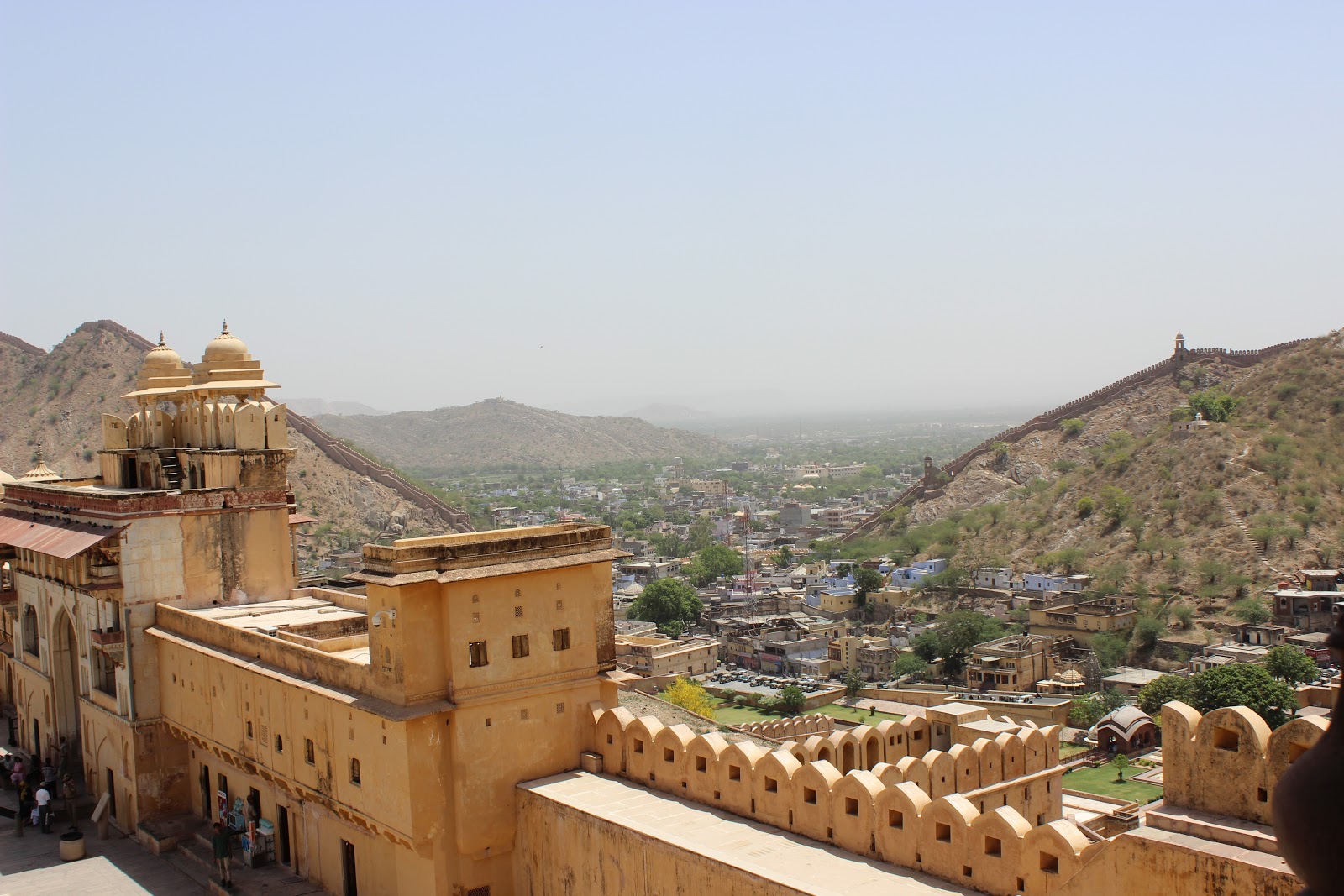
I had hired a guide through my hotel and a driver through the service that my firm uses, so I was all set and ready to go for the day.  Our first stop was the Amber Palace in the Amber City. 

 
The Amber Palace

The Amber City is outside of Old Jaipur, and was the capital of this state before Jaipur was built - the Amber City dates to sometime in the 16th century, but there are ruins around here as old as the 14th century or older.  Jaipur became the capital when the poplation was too big for the Amber City, and since the Amber City is surrounded by hills there was no room to expand.


Hills surrounding the Amber City

There are 103 elephants in Jaipur, and most of them are employed by giving tourists rides up the hill to the top, where the Amber Palace is situated.  Unfortunately I got there too late in the day to get an elephant ride - most elephants only do one round trip up and down the hill per day, so you have to get there early to take advantage of this.  We did pass a couple elephants walking home after they had done their duty, though...

 
Hi, Mr. Elephant!
 

The Amber Palace was absolutely beautiful.  It was built by a maharaja with 12 wives, so there is a master bedroom and then 12 bedrooms one after the other, each for a different wife (called maharanis).  The maharanis were not allowed to even speak to one another without permission from the maharaja and a representative of their husband present at the conversation taking notes - they were definitely birds in a gilded cage. 
 
 
A view of the residential courtyard.  The area in the middle is where the women would be allowed to have supervised talks. If they spoke without permission, the area in the middle is where they would be punished by being forced to grind grain, while the other 11 wives watched on in judgment.  
 
The maharanis wore ridiculous outfits that weighed up to 20 lbs plus another 20 lbs of jewelry.  Their clothing and jewelry weighed so much that they weren't able to walk with it on, so the palace was built with ramps everywhere to accomodate the wheelchairs that the maharanis used (pulled by two servants, of course) to get around. 
 
Imagine this being your window to the outside world because you're a woman and the outside world isn't allowed to see you...
 
The current maharaja is only 15 years old - it seems that the maharajas in this area all had difficulty having sons - most only had daughters, so there have been many issues with succession over the centuries.  The last maharaja adopted his eldest grandson and made him his heir, so that when the last maharaja died (last year at the age of 80), his teenage grandson (now adopted son) took the throne.  Royalty here has no real political power - similar to how royalty acts in the UK these days.  However, they are very rich and own a lot of land and businesses, and much is expected of them in terms of being leaders and role models. 
 
The Moon Palace, where the current maharaja lives.  The small flag on top of the big flag indicates that he is inside the palace today.
 
The palace was intentionally designed so as to confuse any marauding attackers.  Apparently there were hill tribes that frequently attacked it, so it definitely has a somewhat maze-like feeling to it.  One of my favorite rooms in the hotel was the area of the palace that was used in the winter.  The walls and ceilings were inlaid with mirrors that reflected light and also absorbed heat from the oil lamps that were placed around the rooms.  This area was mostly used for the maharaja to hold private audiences with guests. 


View of the audience hall in the winter section of the palace
 
The larger, less adorned reception area that was used for the public is on the outer part of the palace.  If you're standing in direct sunlight, it feels like you're baking on the pavement.  Thankfully, the kings used to put up tents over the area where the general public (male only, of course) would sit and wait to get the attention of the king and his advisers.  They don't keep any of those tents around any more, so I was happy to stand in the shaded area where the maharajas sat...
 
 
Where the maharaja would sit on his velvet pillows...


After the Amber Palace we went shopping at a local marketplace.  The markets in Jaipur are closed today for a political rally, but this one was open because it was in the Amber City.  I looked at rugs - but decided not to get one since I already have a Turkish rug, and I ended up buying myself a lovely blue topaz pendant and ring as an early 30th birthday present to myself (yay!). Jaipur is known for its jewelry - apparently the majority of all the emeralds in the world come from the mines in Jaipur.  They had a lot of beautiful stuff - Mom would love this place :)  In addition, they did a demonstration for me of color block printing, which is very popular here.  It's a method used to dye or paint fabric using vegetable-based colors and carved wooden blocks.  One block will have the outline of the shape (e.g. a camel) and the other block will fill in the color.  It was very interesting, but I didn't really feel in the mood for buying textiles today.

After that we went for lunch. It really was scorching hot, so I was happy to get inside in an air conditioned place. While driving, we passed another palace - the Lake Palace - that literally is in the middle of a lake.  It looks so glamorous and amazing, but we can't visit it since it's under renovation.

It looks like it's floating, but it actually rests on a small island in the lake (which is man-made, unfortunately)...

 
Stunning...

 I ordered the vegetarian thali for lunch - this time I actually took a photo so you can see what a thali looks like:

From front right: Raita, fresh salad, ladue dessert, rice, dal, mixed veggie curry, paneer tikka masala, and roasted aloo...YUM


This gentleman stands outside the restaurant and opens the door for people coming in.  Love the mutton chops.

After lunch we went to the only working astrological observatory in India.  It was filled with these massive instruments that astrologers will use for various purposes like constructing horoscopes.  It also houses the largest working sundial in the world.  Given the importance that this culture puts on star signs and whatnot, it is impressive to see what they've built to honor it.

Sundials

Used to find out what your star sign is

The observatory
 
Some instrument used for people with my zodiac sign (Cancer)


We next went to the City Palace.  Since it is owned by the maharaja, not all of it is open to the public, but a few areas have been converted into a museum for clothing of the maharajas and maharanis plus the throne room (!).  Photos weren't allowed inside, but I did take a few of the palace's exterior.
 
Palace glamour

The huge silver jars inside the pavilion were used to carry water from the Ganges with a maharaja when he was traveling, since he drank it every day for religious reasons.  They're in the Guinness Book of World Records for being the largest silver jugs (or something like that)...
 
With that, we are done for the day.  My guide did say something rather cryptic to me as we were leaving the City Palace - he told me to watch out for the driver of my rented car, that the driver is "a very cunning man."  We were just walking up to the car as he said it, so I didn't have time to ask him to clarify what he meant.  Regardless, I don't want to take any chances, so I cancelled my car for tomorrow and am going to hang out around my absolutely beautiful hotel instead.  Better safe than sorry!  Tonight I'm supposed to meet up with my friend Johanne's friend Roopam, who lives here and is going to go eat dinner with me.  Should be fun!


Domestic travel

Last night I flew from Mumbai to Jaipur.  Domestic travel in India is definitely different than in the US.  For example, there is a separate "ladies" line at security, which has all female officers, and a screened area for them to wand over you with the metal detector (something everyone has to go through, regardless of whether you made the larger metal detector beep).  People don't seem to respect the concept of waiting in line here, as several people just jumped right in front of me and put their bags into the machine while I was taking out my laptop.  The domestic airport in Mumbai is pretty decent - relatively new, clean, with shops, etc.  In order to even get into the check-in area you have to prove that you have a flight to get to, so there are armed guards at the entry into the airport, checking that you have a printed out itinerary that matches your ID.  I did not have a printed itinerary, but thankfully the airlines have kiosks there for you to print out your itinerary for a nominal fee (well, $2 US, which is way more than nominal here).  I got there pretty early, since I wasn't sure what to expect, so once I was checked in and through security I had some time to kill.  There was a foot massage/reflexology shop in the terminal, so I decided to go give it a try.  I've never had reflexology done on my feet before, but wow does it feel good.  The interesting part of the experience was that my masseur was blind - he did everything by touch and was very careful about putting his fingers in the right place on my feet.  He was very good at what he did, and I can't imagine it would be easy to be in his profession with that kind of a condition, so I was impressed with his abilities.  The parlor itself had a bunch of different comfortable chairs with people getting their feet rubbed - I, however, was the only female customer.  The lights are low and soft music is playing - definitely a relaxing atmosphere, but I did feel a little out of place.

I'm very happy to be a frequent traveler, beacuse otherwise I might have freaked out when I looked at the flight board and saw this:

It turns out that this board rotates between Hindi script and letters that I can actually read, but it gave me a bit of a start when I first glanced at the board :)

Once on the plane, it's a very similar experience to the US.  Except there are more babies.  And the babies aren't necessarily wearing shoes...even if they're old enough to walk.  I had an exit seat, but the weird thing about it is that they don't let you have any bags underneath your seat if you're in the exit row - even if the bag is small and fits completely under the seat in front of you.  On that one particular point, Indian airlines seem to be more strict than Americans!  But when it comes to taking off your shoes at security or putting your liquids in small containers and clear plastic bags, they couldn't care less. 

Once I arrived in Jaipur, I started looking for a taxi.  For those of you who know the story, you will understand why I was having flashbacks to my last trip to India, when my search for a taxi ended up with me parading around the airport with a cohort of armed military men with automatic weapons in tow.  Thankfully, this arrival was much more tame.  I found the cab stand window outside, paid the pre-paid fare and went to my hotel.  This is by far the most expensive taxi I've had to take since I arrived in India (about $10 US), so I'm pretty sure I got ripped off, but in the end it doesn't really matter.

That's all for now...stay tuned for info on the pink city of Jaipur...

Friday, 17 May 2013

Boothies in Bombay

Last night I went out to dinner with some of my fellow incoming classmates to the University of Chicago Booth School of Business Class of 2015.  It was wonderful to meet these people - they were all very friendly and nice.  The group apparently gets together pretty frequently, so I will be seeing more of them while I'm here, hopefully.  It would be great to know some people before starting school.  We went to dinner at a Japanese restaurant called Aoi (pronounced ah-wee - though clearly I knew that immediately without it having to be explained to me) in Bandra.  The group ordered a bunch of sushi rolls, and the other vegetarian and I shared a couple different rolls.  I realized (too late) that the rolls had fresh, uncooked veggies in them - uh oh.  I haven't been eating any veggies that haven't been cooked, and if they've been peeled, then it has to have been in my presence.  I'm mentally freaking out a little at dinner about having my classmates' first impression of me to be "the girl who got food poisioning," but thankfully nothing happened!  Either the restaurant was very clean (which it seemed to be), or my stomach is getting stronger, but regardless I was able to enjoy the night and the food.  My classmates seemed to think my choice to go vegetarian while in India was a little funny - only one other person is a vegetarian, and it was the other girl at the table (who I had met at the Booth event last weekend, actually).  The guys all seemed very into meat - one of them even ordered an entree with steak in it!  It was interesting to see him first ask permission from the table if they were ok with him ordering it, though - he didn't want to offend anyone's religious or cultural sensibilities. 

After dinner some of the group went to a bar in Bandra called The Daily - I didn't stay long, but while I was there, a classmate encouraged me to try an off-menu drink that he and his friends had invented and that the bar had co-opted called The Bombay Nasty.  I honestly don't know what is behind the "nasty" theme I'm encountering this week, but the drink was definitely delicious.  The rim of the glass had chaat masala spices on it - very Indian.  He asked me to guess the ingredients of the drink, and of course I guessed entirely wrong.  Me: Orange juice and grenadine?  Him: Nope. Watermelon juice.  Me: I can't taste the alcohol, so I'm guessing it's vodka? Him: Nope.  Me: Gin? Him: Nope.  Me: (drawing a blank) Him: It's rum (shakes his head).  Whoops - clearly my palate isn't very refined when it comes to mixed drinks.  I ended the night early because I wanted to finish packing for Jaipur tomorrow, but am glad that I spent time with my soon-to-be classmates!  Paresh called me when I was just arriving home around midnight - honestly, I don't think this guy knows how to operate a phone during normal business hours.  I'm getting a little annoyed that he keeps calling me so late - if I weren't acting like such a social butterfly then he'd probably be waking me up on a regular basis (and you all know how much I love my sleep).

Per usual, there are a couple observations that have occurred to me along the way that I'd like to share.  The first is about the office water cooler.  I am incredibly thankful that the office has large water coolers stationed around every floor with a familiar brand of bottled water in them - it allows me to drink lots of water during the day.  To do so, I bring a water bottle in with me every day and keep filling it up.  Many people don't seem to have cups or water bottles at their desk, however, and I was curious about how they drink water during the day.  In the US, water coolers will usually have a stack of disposable cups nearby that people can use, but these coolers don't.  In fact, they only seem to have a single disposable cup that rests on top of the water jug.  Yesterday I realized that these cups are communal cups!  People fill up the cup, drink their fill, and then put the cup back on top of the jug for the next person to use.  EWW - how gross is that???  I like my colleagues, but I have absolutely no desire to swap spit with them!  I think I'll stick to my private water bottle, thank you very much...

Another thought that occurred to me yesterday is that people very rarely will drink any kind of beverage when they're eating lunch.  I typically bring my water bottle down to lunch with me and noticed that everyone else is just eating - not drinking at the same time.  This doesn't happen at restaurants for dinner, but only at lunch.  I'm honestly not sure why this phenomenon occurs, but my current hypothesis ties back to the fact that people don't actually carry containers for liquid with them at work. If they don't have water bottles, and there's only one communal cup, then no one brings water to the lunch table with them.  There is of course the option to buy drinks in the cafeteria, or to get a free cup of coffee or chai, but no one does that.  It's interesting...I'm going to ask around and see what people say.